Wednesday, August 19, 2009

Freddy the Politician

There's so much to say about Freddy the Pig that it's hard to begin. So, aiming randomly and seeing what we happen to hit, let's start with Freddy the Politician.

This book comes in during Freddy's golden age. For the first couple of books in the series, Mr. Brooks has not yet realized that Freddy is the character around which this barnyard ensemble revolves, scattering the focus and preventing the lovely sense of organic wholeness that pervades the rest of the series. And, later, after a couple dozen books, Mr. Brooks runs out of fresh ideas.

But in the middle of the series -- from the third or fourth book until about the 20th or so -- it's marvelous good fun.

In Freddy the Politician, the animals find a need to (1) open a bank, and (2) form a government and elect a leader. Plot complications include the accidental arrival of some pushy, officious woodpeckers from Washington. In lesser hands, this could fall into cliches pretty quickly. But with Freddy, we get a tantalizing glimpse into the workings of the real adult world, while never losing the comic momentum. Where else in children's literature do (funny, believable) plot developments hinge on correct parliamentary procedure (I don't think you can count Alice, because all rules are off in that world) or voter registration laws?

Serious stuff, but never too serious. As with all Freddy books, there's a comforting familiarity to finding the series' mandatory elements -- an episode in which Freddy must don a disguise, some terrible poetry, a thwarted attempt by Charles to make a speech. The peril is never too great -- Freddy and his friends always end up on top in the end -- and there is always genuine laugh-out-loud humor, including wordplay the adult reader will have to explain to the child listener.

It's a gentle mirror on the real world. But the adult reader will probably let some things remain fiction -- like when the First Animal Republic, briefly derailed under a dictatorial leader, starts annexing neighboring farms in this book, published in 1939.

Tuesday, July 21, 2009

Slug roundup

Sluggy Slug just won't go. What if Sluggy Slug is bribed with sweets? Will Sluggy Slug remain true to character, even when confronted with the powerful temptation of refined white sugar?

That's pretty much the whole story of Sluggy Slug. And yet, it's enough. It's the rare easy reader board book that's droll enough to make up for the extremely limited vocabulary.

Funny thing about slugs -- so unappealing to step on barefoot (even worse in socks) and yet so charming in a children's book. Or as a stuffed animal. Or both -- as in Bunny Party, one of the many Max and Ruby stories by Rosemary Wells.

Formulaic? Yes, but it's not about the story. It's about Max's party guests, including Can't-Sit-Up-Slug, who ends up slumped on the table.

It figures. How like a slug.

Thursday, July 9, 2009

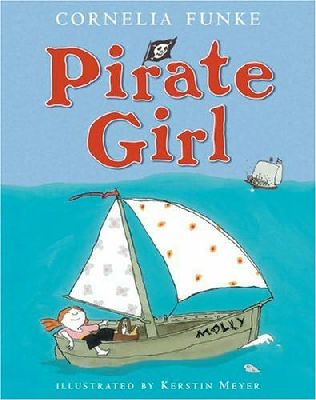
Pirate Girl

Not everything Cornelia Funke writes is 500 pages long. She's also written a number of picture books for young children --not all of them very good.

But here's one that is. The story is a simple one. Fearsome pirates make a mistake when they capture a little girl named Molly, who is off on a trip to visit her grandmother. Despite being cruelly mistreated, she refuses to cooperate and quietly plots her escape.

To describe the resolution would be to spoil the book. But it's that rarest of things: a girl-power book that charms me and my seven-year-old both.

Friday, May 22, 2009

The Illustrated Wee Free Men

Oddly, the presentation of Wee Free Men as an illustrated storybook ... works. I would not have expected that, but the act of illustrating the story's horrible nightmare monsters makes them lose much of their power. So here we have a Terry Pratchett book that can be read aloud to a six-year-old.

Sunday, April 12, 2009

Two Durrells

I stopped reading Lawrence Durrell's book The Greek Islands after it irritated me for fairly trivial reasons -- he called an island dear to me "a bit of a slut." So, I had felt slightly guilty for failing to sample his purported literary masterwork, the Alexandria Quartet.

Not any more!

http://www.themillions.com/2009/04/modern-library-revue-70-alexandria.html

Much as I suspected.

While elder brother Larry was launching his literary career, little brother Gerry, unwittingly anticipating the unschooling movement by several decades, was running barefoot on Corfu, working on his nature collection and, evidently, his comic prose style. (As often happens, it's the youngest sibling who gets the sense of humor.) My Family and Other Animals, Gerald Durrell's memoir of his childhood years on Corfu, is a perfectly delicious book. I'm crossing my fingers that the two sequels are half as good.

Saturday, April 11, 2009

Peter and the Starcatchers

Peter and the Starcatchers, by Dave Barry and Ridley Pearson, is such an awful book that I'm not going to wait until I finish to review it.

This book is an effective, non-habit-forming substitute for a sleeping pill. Allegedly a prequel to the J.M. Barrie classic, it is sheer torture to read aloud, draining the life force out of the reader with every artless, plodding, cliche-ridden sentence. The characters are wooden, the attempts at humor are vulgar and/or disgusting (but what did I expect from Dave Barry?), and the story line is predictable and tedious.

I would drop it immediately if I weren't reading it aloud to a six-year-old who wants to find out how it ends. Learn from my experience -- don't start.